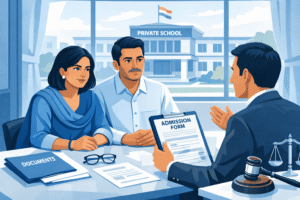
You must have seen parents complaining on social media about private school fees, management decisions, compulsory purchases of uniforms or stationery from the school, or schools refusing to return documents when a child leaves. These issues come up frequently in parent groups, local forums, and news reports.
Many parents assume private schools can make their own rules because they are privately run institutions. In reality, that is not correct. Private schools in India are regulated by several national laws and education board rules. These laws protect parents and students from unfair admission practices, illegal fees, harassment, and denial of documents.
If you are admitting your child to a private school in India or your child is already studying there, it is important to understand the legal rights you have as a parent. These rights come mainly from the Right to Education Act (RTE), board rules such as CBSE regulations, disability laws, and child protection laws.
Can Private Schools Force Fees or Withhold Documents? Parents’ Legal Rights in India
This guide explains the key legal rights parents have during school admission and throughout their child’s education, along with the official complaint portals you can use if a school violates those rights.
1. The Right to Education (RTE) Act Protects Children and Parents
The most important education law in India is the Right of Children to Free and Compulsory Education Act, 2009. It guarantees education rights for children aged 6 to 14 years.
Under the RTE Act, schools cannot deny a child admission or treat students unfairly in several ways.
Key rights under the RTE Act include:
- Schools cannot charge capitation fees or donations for admission.
- Schools cannot conduct screening tests or interviews for admission at the elementary level.
- Admission cannot be denied because parents do not have immediate age proof.
- Children cannot be expelled or held back until completion of elementary education.
- Schools must issue a Transfer Certificate immediately if a student moves.
- A child cannot be denied admission because the previous school delayed the TC.
You can read the full RTE law here: Right to Education Act – Official Government Text
2. Private Schools Must Reserve 25% Seats for Economically Weaker Sections
Under Section 12(1)(c) of the RTE Act, many private schools must reserve 25% of entry-level seats for children from economically weaker sections and disadvantaged groups.
This rule applies mainly at the entry level such as nursery, kindergarten, or Class 1 depending on the school structure.
The school cannot discriminate against children admitted under this quota and must provide the same facilities and education as other students.
3. Schools Cannot Force Parents to Buy Books or Uniforms from Specific Shops
Many private schools attempt to force parents to purchase uniforms, books, or stationery only from the school campus or a specific vendor.
However, CBSE has clearly directed schools not to pressure parents to buy educational materials from selected vendors.
Parents are free to purchase books, uniforms, and stationery from any shop as long as they meet the school’s specifications.
You can see the CBSE circular here: CBSE Circular on Sale of Books and Uniforms
4. Schools Cannot Charge Hidden or Arbitrary Fees
Private schools can charge fees, but they must do so transparently and reasonably.
CBSE rules require that:
- Fees must match the facilities offered by the school.
- Schools should consult parent representatives before increasing fees.
- Fee increases should not happen in the middle of an academic session.
- If a student leaves mid-session due to parent transfer, health reasons, or death, certain fees must be refunded on a prorated basis.
CBSE affiliation rules can be viewed here: CBSE Affiliation Bye-Laws
5. Schools Cannot Withhold Transfer Certificates or Original Documents
A common problem parents face is when a school refuses to return original documents or delays issuing a Transfer Certificate.
Under the RTE Act, when a student moves to another school, the previous school must issue the Transfer Certificate immediately.
Importantly, even if the TC is delayed, the new school cannot refuse admission on that basis.
If a school is withholding documents or refusing to issue a TC, parents can file a complaint with the education authorities.
6. Corporal Punishment and Mental Harassment Are Illegal
Indian law strictly prohibits physical punishment and mental harassment in schools.
This includes:
- Physical punishment
- Humiliation in class
- Public shaming
- Verbal abuse
- Threat-based discipline
These actions violate Section 17 of the RTE Act.
The Ministry of Education has also issued safety guidelines to ensure schools provide a safe and respectful environment for students.
School Safety Guidelines – Ministry of Education
7. Children With Disabilities Cannot Be Denied Admission
The Rights of Persons with Disabilities Act, 2016 protects children with disabilities from discrimination in education.
Schools must:
- Provide inclusive education
- Offer reasonable accommodations
- Ensure accessibility of campus and learning materials
- Provide examination support such as scribes or extra time when required
The official law can be read here:
Rights of Persons with Disabilities Act 2016
8. Private Schools Must Be Officially Recognized
No private school in India can operate legally without government recognition.
If a school does not meet required standards such as infrastructure, teacher qualifications, or safety measures, recognition can be withdrawn.
Parents can raise complaints if a school is operating without proper recognition or violating recognition conditions.
9. Where Parents Can File Complaints Against Schools
If a school violates a child’s rights or refuses to return documents, parents have several official complaint options.
1. Local Education Authority or District Education Officer
Under the RTE Act grievance system, parents can file complaints with the local education authority responsible for schools in their district.
2. National Commission for Protection of Child Rights (NCPCR)
The government provides an online complaint portal called eBaal Nidan where parents can report violations of children’s rights.
NCPCR eBaal Nidan Complaint Portal
3. Himachal Pradesh Government Complaint Portal
If you live in Himachal Pradesh, you can submit complaints through the state grievance system.
Himachal Pradesh CM Seva Sankalp Complaint Portal
4. CBSE Public Grievance Portal
If the school is affiliated with CBSE, parents can also file complaints directly with CBSE.
10. Practical Tips for Parents When Facing a School Dispute
If a school refuses to return documents, denies admission unfairly, or pressures you with illegal fees, follow these steps:
- Send a written request to the school principal.
- Keep copies of all communication.
- Collect fee receipts and admission records.
- Document conversations and messages.
- If the issue is not resolved, file a complaint with the education authority.
Always mention the relevant laws such as the RTE Act in your complaint. Schools are far more likely to respond quickly when parents cite the correct legal provisions.
Conclusion
Private schools play a major role in India’s education system, but they are not free to operate without rules. Indian law clearly protects students and parents against unfair admission practices, illegal fees, harassment, discrimination, and document withholding.
Understanding these rights helps parents ensure their child receives education in a fair and respectful environment. If a school violates these rights, parents should not hesitate to use official complaint mechanisms provided by the government.
Being aware of these laws is the first step toward protecting your child’s educational rights.